Project Reflections

Community Belonging
While planning our community gardening education event, I unexpectedly found myself joining one of the most supportive and passionate groups of people I have been a part of. The community gardening event was aimed at sharing resources and information with the parents of the Boys and Girls Club and general community to start their own gardens or access fresh produce. In the process of inviting other community partners to join us and share about their programs, I expected to get ignored by half of them as typical cold emailing usually goes. To my pleasant surprise, all of the organizations I had emailed got back to me, were eager to learn more, and were willing to help in some capacity. My heart was warmed by the generosity of all these community members, many of who were volunteering their time to help with my project. In particular, I was able to connect with Stacey Crnich and Stephanie Lyon from GoodRoots Northwest, a nonprofit organization promoting food security and access to fresh nutritious roots in Washington. I reached out to them initially to join us for our community gardening education event. Although they both were so busy managing the nonprofit, they took the time to meet with me and connect me to other resources in the gardening and fresh produce food security community that I could invite to our community gardening education event as well. Thanks to them, I was able to get in contact with two of our community event partners, the WSU Extension Master Gardeners and The Making a Difference Foundation. In addition, I was able to drive out to visit their main distribution site in Buckley, Washington, where I learned more about their mission, how their nonprofit came to live, and how they continue to grow their operations to serve our community better. The experience of connecting with selfless community members such as Stacey and Stephanie made me feel a part of this smaller community of people devoted to fresh food access and sustainability.
This community was built up of people passionate about gardening education, environmental action, and fresh produce access for all. Even though my project was just starting, I already found myself belonging to this great community. For me, this belonging came from a common mission and drive to help the greater Tacoma community. In addition, once I had joined this community, I felt that hearing from others with similar passions gave me new ideas and motivation to work harder on my project. I was able to visit other student gardens to get future ideas on how we might expand the Boys and Girls Club garden for future years, and I am excited to build on this project with the support of my newfound community. In addition, I am eager to share these resources and lessons learned with any new members of our gardening and fresh produce food security communities.
Myths of Community Engagement
Last year, I heard a talk from Mr. Larry E. Thomas, the founder of the Thomas Mentor Leadership Academy (TMLA) that changed my outlook on how I used to approach creating new community service projects and motivated me further to pursue the garden. The TMLA is a Durham nonprofit that provides well-rounded mentorship for young males being raised by a single parent to provide positive role models and support. He spoke about how although he would have wanted to help all children in Durham, his organization only has the capacity to serve a certain number of students. He chose this population of young males with single parents because he connected with them and has a passion to support them. He implored us to create new solutions in our communities by targeting a single problem that you identify with, and then come up with a realistic solution to improve that in your community.
Mr. Thomas addressed a common myth that launching your own community initiative is extremely difficult, should maximize the amount of people you serve, and requires large amounts of resources. This encouraged me to start the smaller steps to work on this garden project that I had been interested in previously, but thought that I never had the time to fully do. In addition, the opportunity to be a part of the Brodhead Service Program provided me with the funding and mentorship needed for this garden project. The process of working incrementally on steps to create the garden and the educational programs allowed me to learn the process of creating a community initiative from scratch. I learned to create project goals of realistic size for me to complete in my 8 weeks. Going forward, I understand that with passion to solve a community issue, any initiative can be put into action with realistic goals and a plan. Although this garden is currently serving only one branch of the Boys and Girls Clubs of South Puget Sound, I hope to continue this work step by step to expand to more branches in the future.
A Meaningful Moment
On our last education day for the summer, we went outside for some routine garden maintenance, but we were greeted with a pleasant surprise. The students were pruning some of the giant zucchini squash leaves and they realized one of the growing zucchinis was fully grown. Although one zucchini seems like a small achievement to celebrate, the students were so proud of their hard work in the garden that had resulted in a fully grown vegetable ready to consume. That moment of watching the excitement and interest in the gardening club students will be forever memorable. One of my initial goals in this project was to create educational activities about sustainability and urban gardening. However, the excitement in the students also made me realize that my real goal beneath that was to spark interest for them to seek out further learning about those subjects through hands-on work. In community work, although sometimes the results might be slow (just like growing vegetable plants from seeds), seeing the smiles and impact of your work is so fulfilling and something that motivated me further to continue this project in the next growing season.

Wesley pointing to our garden's first zucchini!
Gratitude
My garden project this summer was supported and would not have been possible without the help of many instrumental mentors and organizations.
Thank you to everyone at the Boys and Girls Club of South Puget Sound D.A. Gonyea branch who helped out during our gardening club activities. In particular, thank you to Taylor Anzivino, Ciara Brantley, and Makenzie White for your great enthusiasm and logistical support with setting up the gardening club.
Thank you to my community partners from the Institute for Systems Biology, Claudia Ludwig and Sarah Clemente, for your mentorship and help with developing all the garden club lessons.
Thank you to Misha, my Brodhead Fellows mentor, for her advice and motivation while brainstorming logistics of my project.
Finally, thank you to the Brodhead Service Program and DukeEngage for making this project possible!
Next Steps
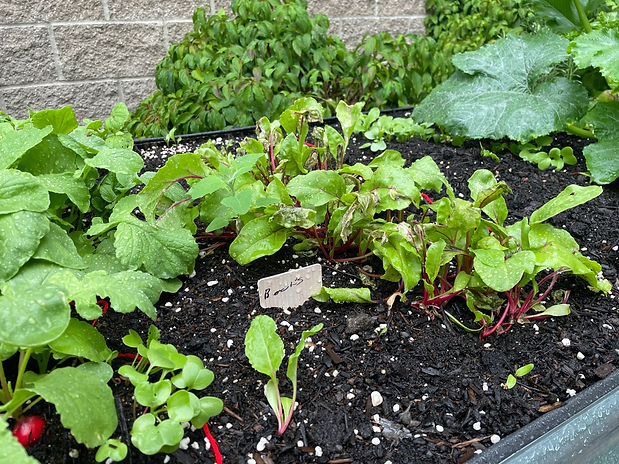
The best part about this garden project is that it can be planted in for years to come and our garden has a lot of surrounding open space to add more planters or pots for the students to add new vegetables to their garden. The students will be completing their first harvest of radishes, beets, carrots, zucchini squash, kale, two varieties of lettuce, rosemary, and basil in the coming month as we near the first frost of Washington in October. Next year, since the garden will be ready to go early in the season, I am excited for the gardening club to have their first full season of vegetable and fruit planting where they can grow crops that require a longer cultivation. The students have already requested to add strawberries to our list of plants for next year! I will be returning in March and then May to assist them with refreshing the nutrients in the garden soil and starting the planting process. In addition, thanks to a great idea from WSU Extension Master Gardeners, I plan to add an ‘herb spiral’ structure where herbs can thrive and continue to provide leaves throughout the summer. I was able to explore other community/student gardens near Tacoma and got some great inspiration on how to continue growing our gardening club further.